(800) 707-9111
 Call
Call
Table of Contents
A workplace injury can turn your life upside down overnight. One moment you are doing your job — the next you are dealing with pain, medical appointments, missed paychecks, and uncertainty about your future. Florida’s workers’ compensation system is designed to help injured workers get back on their feet. In practice, however, navigating that system is rarely straightforward.
Claims get denied. Benefits fall short of actual losses. Employers and insurers push injured workers back to work before they are ready. If you have been hurt on the job in Florida, understanding your rights — and having an experienced attorney in your corner — can make a significant difference in the outcome.
Kogan & DiSalvo Personal Injury Lawyers helps injured workers throughout Florida navigate the workers’ compensation process, fight wrongful claim denials, and explore every avenue for full and fair recovery.
Injured on the job in Florida? Call Kogan & DiSalvo Personal Injury Lawyers today for a free consultation.
How Florida Workers’ Compensation Works
Florida’s workers’ compensation system is a no-fault system, meaning that injured employees generally do not need to prove that their employer was negligent in order to receive benefits. If you were injured at work or developed an occupational illness as a result of your job, you are typically entitled to benefits regardless of who caused the accident.
In exchange for this no-fault coverage, workers’ compensation laws generally limit an injured worker’s ability to sue their employer directly in court. However, this trade-off does not mean you are limited in every situation — and it does not mean you are at the mercy of the insurance company.
Florida requires most employers with four or more employees to carry workers’ compensation insurance. Construction employers must carry coverage with just one employee. When an employer fails to carry required coverage, additional legal options may be available to injured workers.
What Benefits Are Available Under Florida Workers’ Compensation?
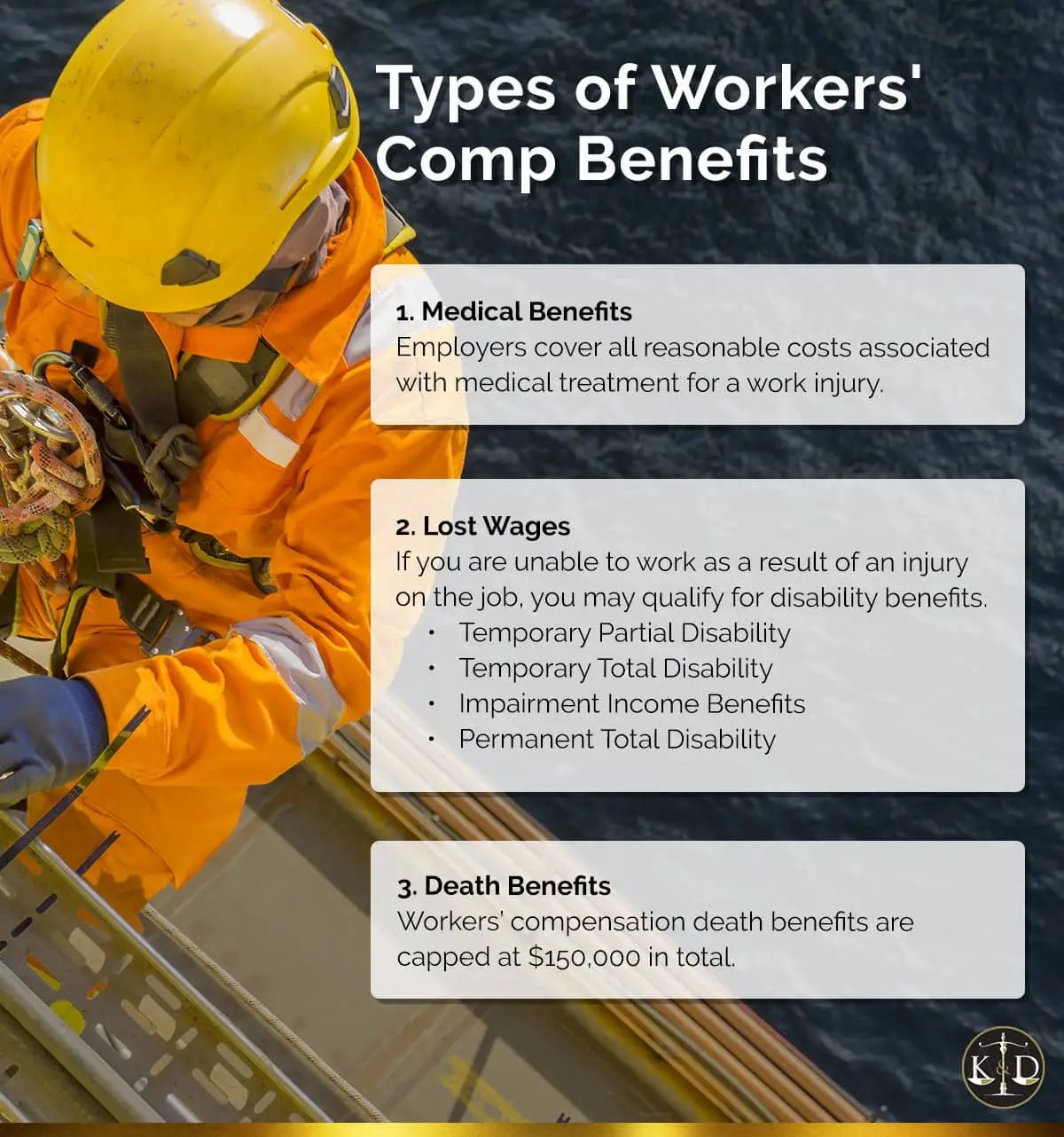
Florida workers’ compensation provides several categories of benefits to injured employees. Understanding what you are entitled to helps ensure you receive everything the law provides:
- Medical benefits — All reasonable and necessary medical treatment related to your work injury must be covered by the workers’ compensation insurer. This includes emergency care, hospitalization, surgery, physical therapy, prescription medications, and ongoing specialist treatment. You must generally treat with an authorized provider selected by the employer or insurer.
- Temporary Total Disability (TTD) — If your injury leaves you completely unable to work during your recovery, you may receive TTD benefits equal to 66.67% of your average weekly wage, subject to a state-set maximum.
- Temporary Partial Disability (TPD) — If you can return to work in a limited capacity at reduced hours or pay, TPD benefits may make up a portion of the difference between your pre-injury and post-injury earnings.
- Permanent Impairment Benefits — Once your condition reaches maximum medical improvement (MMI), your treating physician assigns an impairment rating. This rating determines a set number of weeks of impairment benefits you may receive.
- Permanent Total Disability (PTD) — If your injuries are so severe that you will never be able to return to gainful employment, you may be entitled to permanent total disability benefits for an extended period.
- Death benefits — If a worker is killed on the job, their surviving dependents may be entitled to death benefits, including funeral expenses and ongoing financial support. Our Florida wrongful death attorneys can help families understand their full rights in these situations.
Workers’ compensation benefits are not always straightforward to obtain. Insurers regularly dispute the extent of injuries, challenge impairment ratings, and try to limit the duration and scope of authorized treatment. Kogan & DiSalvo Personal Injury Lawyers helps injured workers push back against these tactics and secure the full benefits they are owed.
We’re here to help you understand your rights. Call Kogan & DiSalvo Personal Injury Lawyers — let’s talk about your situation.
Common Reasons Workers’ Compensation Claims Are Denied in Florida

A denied workers’ compensation claim does not mean your case is over. Many denials can be successfully challenged — but you need to act quickly, as there are strict deadlines for appeals. Common reasons for denial include:
- Late reporting — Florida law requires injured workers to report their injury to their employer within 30 days. Failing to report within this window can jeopardize your claim.
- Disputed work-relatedness — The insurer claims the injury did not occur at work or was not caused by job duties.
- Pre-existing condition disputes — The insurer argues that your injury is a pre-existing condition rather than a new work injury, or that your work only aggravated a prior condition minimally.
- Missed deadlines — There are strict procedural deadlines throughout the workers’ compensation process. Missing them can result in loss of benefits.
- Lack of witnesses or documentation — Without a clear record of the accident and injury, insurers may dispute what happened.
- Employer disputes — Some employers dispute that the injury occurred at work, particularly in cases involving repetitive stress injuries or occupational illnesses that develop gradually.
- Alleged violation of a safety rule — If the employer claims you were injured because you violated a workplace safety policy, this may be used to reduce or deny benefits.
If your claim has been denied or your benefits have been reduced or terminated, Kogan & DiSalvo Personal Injury Lawyers can review your case and advise you on the best path forward. We handle workers’ compensation disputes before the Florida Office of Judges of Compensation Claims (OJCC) and fight for the benefits injured workers deserve.
When Can You Sue Outside the Workers’ Compensation System?
While workers’ compensation generally prevents employees from suing their employer directly, there are important exceptions that may allow for additional recovery beyond what workers’ compensation provides.
Third-Party Liability Claims
If a party other than your employer caused or contributed to your workplace injury, you may be able to file a personal injury lawsuit against that third party while also receiving workers’ compensation benefits. Common third-party claims arising from workplace injuries include:
- A driver who caused a car accident while you were driving for work
- A property owner whose negligence caused a fall on a job site you were visiting
- A manufacturer whose defective equipment or machinery caused your injury
- A subcontractor or co-contractor on a construction site whose negligence led to the accident
A successful third-party claim can result in compensation for pain and suffering, full lost wages, and other damages that workers’ compensation does not cover — making this avenue critically important in serious injury cases.
Employer Misconduct
In rare but serious cases, an employer’s intentional misconduct or egregious safety violations may open a path to direct legal action. Similarly, if an employer did not carry required workers’ compensation insurance, injured workers may have additional legal options.
Kogan & DiSalvo Personal Injury Lawyers has helped injured workers across South Florida — now we’re ready to help you.
Common Workplace Injuries We Handle
Workplace injuries occur in every industry — from construction and manufacturing to healthcare, retail, and office environments. Some of the most common work-related injuries we see include:
- Construction accidents — Falls from scaffolding and ladders, being struck by falling objects, machinery accidents, and electrocution are among the leading causes of serious and fatal construction injuries in Florida.
- Slip and fall injuries — Wet floors, cluttered walkways, and uneven surfaces cause falls in workplaces of all kinds.
- Repetitive stress injuries — Carpal tunnel syndrome, tendinitis, and back injuries caused by repetitive motions or sustained awkward postures develop over time and are sometimes harder to establish as work-related.
- Machinery and equipment accidents — Caught-in and caught-between accidents, crush injuries, and lacerations from industrial equipment can cause catastrophic harm.
- Vehicle accidents — Workers injured in car, truck, or forklift accidents while performing job duties are covered by workers’ compensation and may also have third-party claims.
- Exposure injuries — Workers exposed to toxic chemicals, excessive noise, or hazardous substances may develop occupational illnesses including respiratory disease, hearing loss, and cancers.
- Overexertion injuries — Back strains, muscle tears, and joint injuries caused by lifting, pushing, or pulling heavy loads are extremely common across many industries.
- Workplace violence — Injuries caused by assaults or violence in the workplace may be covered by workers’ compensation and may give rise to additional claims depending on the circumstances.
Steps to Take After a Workplace Injury in Florida
What you do in the immediate aftermath of a workplace injury can significantly affect your ability to receive full benefits. Follow these steps:
- Report your injury immediately — Notify your supervisor or employer as soon as possible and no later than 30 days after the injury. Do this in writing whenever possible to create a record.
- Seek medical attention — If it is an emergency, go to the nearest emergency room. For non-emergency treatment, ask your employer or insurer for a list of authorized providers. Treating with unauthorized providers may jeopardize your coverage.
- Document everything — Keep records of all medical treatment, correspondence with your employer and insurer, missed work days, and any out-of-pocket expenses related to your injury.
- Follow your doctor’s instructions — Deviating from prescribed treatment or returning to activities your doctor has restricted can be used by the insurer to reduce or terminate your benefits.
- Do not give a recorded statement without legal advice — Insurance adjusters may ask for a recorded statement. Consult with an attorney before agreeing.
- Contact Kogan & DiSalvo Personal Injury Lawyers — Whether your claim is just beginning or has already run into problems, we can help you understand your options and protect your rights.
Florida Workers’ Compensation Deadlines You Should Know
Florida workers’ compensation cases involve strict timelines as set out under Florida’s workers’ compensation statutes. Missing a deadline can have serious consequences for your benefits:
- Report your injury to your employer within 30 days of the accident or discovery of an occupational disease.
- Your employer is required to report your injury to their insurer within 7 days of notification.
- The insurer has 14 days to begin paying benefits or to deny the claim after it is reported.
- If your claim is denied or a benefit dispute arises, you generally have two years to file a Petition for Benefits with the OJCC.
These deadlines apply strictly, and missing them can limit or eliminate your right to benefits. Kogan & DiSalvo Personal Injury Lawyers helps clients understand and meet every deadline in their case.
Frequently Asked Questions About Florida Workers’ Compensation
Can I be fired for filing a workers’ compensation claim?
Florida law prohibits employers from retaliating against employees for filing a workers’ compensation claim. If you believe you were fired, demoted, or otherwise penalized because you reported a workplace injury or filed a claim, you may have a retaliation claim against your employer. Contact Kogan & DiSalvo Personal Injury Lawyers to discuss your situation.
What if my employer says the injury was my fault?
Workers’ compensation is a no-fault system, which means your own negligence generally does not bar you from receiving benefits. However, there are limited exceptions — for example, if you were injured while intoxicated or engaged in deliberate misconduct. In most cases, fault is not the determining issue in a workers’ compensation claim.
What happens if the workers’ compensation doctor says I can return to work but I don’t feel ready?
The authorized treating physician’s opinion carries significant weight in the workers’ compensation system, but you have options. You may be entitled to seek an independent medical examination (IME) or a second opinion under certain circumstances. If you are being pressured to return to work before you are medically ready, Kogan & DiSalvo Personal Injury Lawyers can help you evaluate your options.
Can I receive workers’ compensation and also sue a third party?
Yes. Workers’ compensation and a third-party personal injury lawsuit are not mutually exclusive. If a third party’s negligence contributed to your workplace injury, you can pursue both simultaneously. Be aware that in some cases, the workers’ compensation insurer may have a lien on the proceeds of a third-party settlement — something we navigate carefully for our clients.
How long will my workers’ compensation case take?
Straightforward claims that are accepted and uncontested can resolve relatively quickly. Disputed claims that go before a judge at the OJCC may take considerably longer. The timeline depends on the complexity of the injury, whether liability is disputed, and how aggressively the insurer contests the claim. We keep our clients informed throughout the process.
Contact Kogan & DiSalvo Personal Injury Lawyers Today
A workplace injury should not mean financial ruin or a battle you have to fight alone. Florida’s workers’ compensation system has real protections for injured workers — but accessing those protections often requires persistence and experienced legal guidance.
Kogan & DiSalvo Personal Injury Lawyers serves injured workers throughout Florida, including Fort Lauderdale, West Palm Beach, Boca Raton, Stuart, Delray Beach, and communities across South Florida and the Treasure Coast. We handle workers’ compensation cases on a contingency fee basis — no upfront costs, and no fees unless we recover for you.
Your recovery starts with a call to Kogan & DiSalvo Personal Injury Lawyers. Contact us today for your free consultation.